Decode Scripture
Why the Bible Says God Tests Your Heart and Your Kidneys - Decoded Map
Why the Bible Says God Tests Your Heart and Your Kidneys - Decoded Map
Couldn't load pickup availability
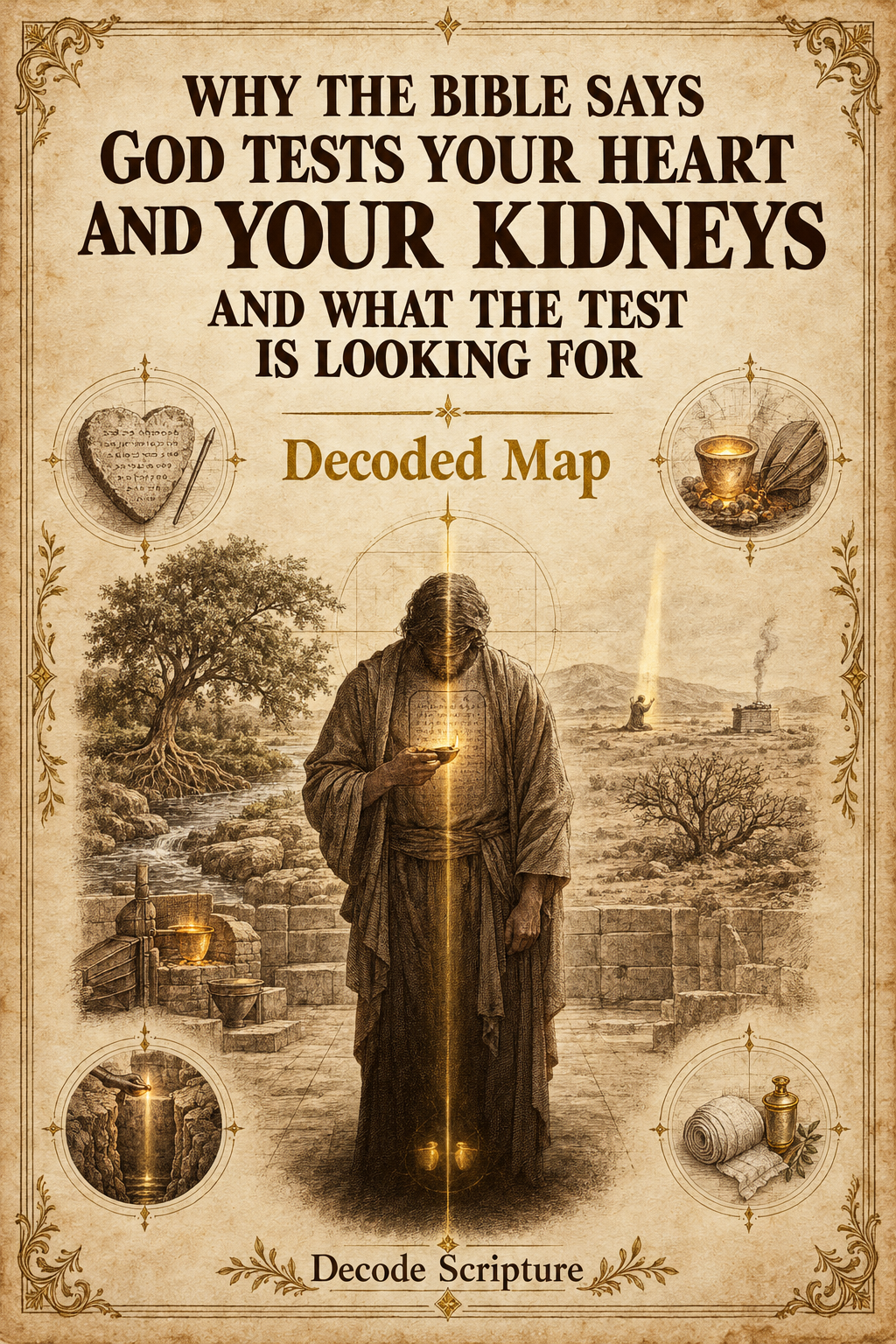
Go deeper into the Decode Scripture episode with this printable Decoded Map on why the Bible says God tests your heart and your kidneys.
This PDF companion is designed for personal study and helps you revisit the core structure behind the episode in a clear, written format.
Inside, you'll find:
• the surface reading that quotes Jeremiah 17:9 as a reason not to follow the heart, and the modern versions that print "mind" where the Hebrew has the kidneys
• the decoded meaning that reads Jeremiah 17:9 as a diagnosis and verse 10 as its answer, with a search that goes past the heart to the kidneys
• key passages decoded from Jeremiah 17:9-10, Leviticus 3:4, Lamentations 3:13, Psalm 16:7, Job, Psalm 7, Psalm 26, Jeremiah 11, Jeremiah 20, Psalm 73:21, Jeremiah 9, Jeremiah 15, Jeremiah 30, Psalm 19, 1 Kings 8, Jeremiah 6, Proverbs, Revelation's letter to Thyatira, Psalm 139, Paul's letters to the Corinthians, and Jeremiah 17:14
• why the King James prints "kidneys" for an animal and "reins" for a person
• the Hebrew words behind "deceitful" and "desperately wicked," one shared with a brother who supplants and one with an incurable wound
• the furnace verb behind "try," and why the search comes before the giving
• the psalms in which a man asks to be examined, and Paul's clear conscience that does not justify him
• the prayer for healing four verses after the search
• cross-tradition readings from the Greek Septuagint, Jerome and the Latin Vulgate, Keil and Delitzsch, Augustine, Radak, and Rashi
• science notes on the heart, kelayot, the five examinations, reins in English Bibles, aqov, anush, search, bachan, and a 2005 history of medicine article on the kidneys in the Bible
• a practice section that follows the passage from diagnosis to prayer
This Decoded Map explores why Jeremiah 17:10 says the LORD searches the heart and tries the reins, and why the reins are the kidneys. Lifted out of its chapter, verse 9 is often quoted as a reason not to follow the heart, while the modern versions most people read put "mind" in verse 10 and none of them prints "kidneys."
The map reads verse 9 as a diagnosis and verse 10 as its answer. The word behind "deceitful" is aqov, crooked, and the word behind "desperately wicked" is anush, a word that belongs to illness rather than crime. No human reads a heart in full, its owner included, but God does, and verse 10 gives the reason he searches: to give every man according to his ways.
The study then follows the kidneys themselves. When the word is used of an animal, even the King James prints "kidneys," taken out in Leviticus 3:4 to be offered to God. Used of a person, it prints "reins," an older English word for the same organ. In the poems the reins are wounded, moved and pricked, and in Psalm 16:7 they instruct in the night seasons, so heart and kidneys together name one inner life.
The chapter speaks of the heart before verse 9 does. Judah's sin is graven on the table of the heart, and the chapter sets two men side by side, one who trusts in man and one who trusts in the LORD, so verse 9 is describing the part of a person that does the trusting. Jeremiah 9 uses the verb behind aqov for the brother who will utterly supplant, and Psalm 19 asks its own "who can" about a person's secret faults.
Solomon's prayer in 1 Kings 8 keeps the inward reading from claiming too much: each person can know the plague of his own heart, while knowing hearts in full is left to God. The verb behind "try" is Jeremiah's furnace verb, and in Jeremiah 20 the examination is a judge's sight. Ways and fruit can be watched from outside, but what they grew from cannot, so the search comes before the giving. In Revelation, the letter to Thyatira gives the searcher a voice.
In Psalm 26 and Psalm 139, the man being examined asks for it, in verse 10's own verbs, and Paul says that a clear conscience does not justify him. Read beside Jeremiah 17, they separate being sincere about one's heart from seeing all of it.
Four verses after the search, Jeremiah prays, "Heal me, O LORD, and I shall be healed." The map presents hearing this as the answer to verses 9 and 10 as a reading, one the commentator Streane reports from the scholar Duhm, and supports it from Jeremiah 30, where the voice that calls the wound incurable is the voice that promises to heal it.
The cross-tradition section follows how early readers heard verse 9's sickness word: as "it is the man" in the Greek Septuagint, as "unsearchable" in Jerome's Latin Vulgate, and as a question about the heart's owner in Keil and Delitzsch, alongside Augustine's Confessions and the Jewish commentators Radak and Rashi.
The science section covers the heart and kelayot in the classic Hebrew lexicon, the five places the Hebrew Bible has God examining the kidneys, how English Bibles translate the reins, the words aqov, anush, search and bachan, and Eknoyan's 2005 history of medicine article on why these organs were chosen.
The practice section follows the passage from diagnosis to prayer. The map does not read the verse as anatomy, does not call the heart innocent, and does not forbid looking inward. It leaves the reader with the question verse 9 ends on: who can know it?
Important: If you are already a Cartographer member, do not purchase this separately. This Decoded Map is already included in your membership library.
This single purchase is for viewers who want the written companion map for one public Decode Scripture episode as a standalone download.
For access to all current public episode maps, future maps, members-only videos, and members-only PDFs, join The Cartographer tier.
Delivery: This is a digital download. No physical item will be shipped.
Share