Decode Scripture
Saying This Name Was Death. You've Said It a Hundred Times Today - Decoded Map
Saying This Name Was Death. You've Said It a Hundred Times Today - Decoded Map
Couldn't load pickup availability
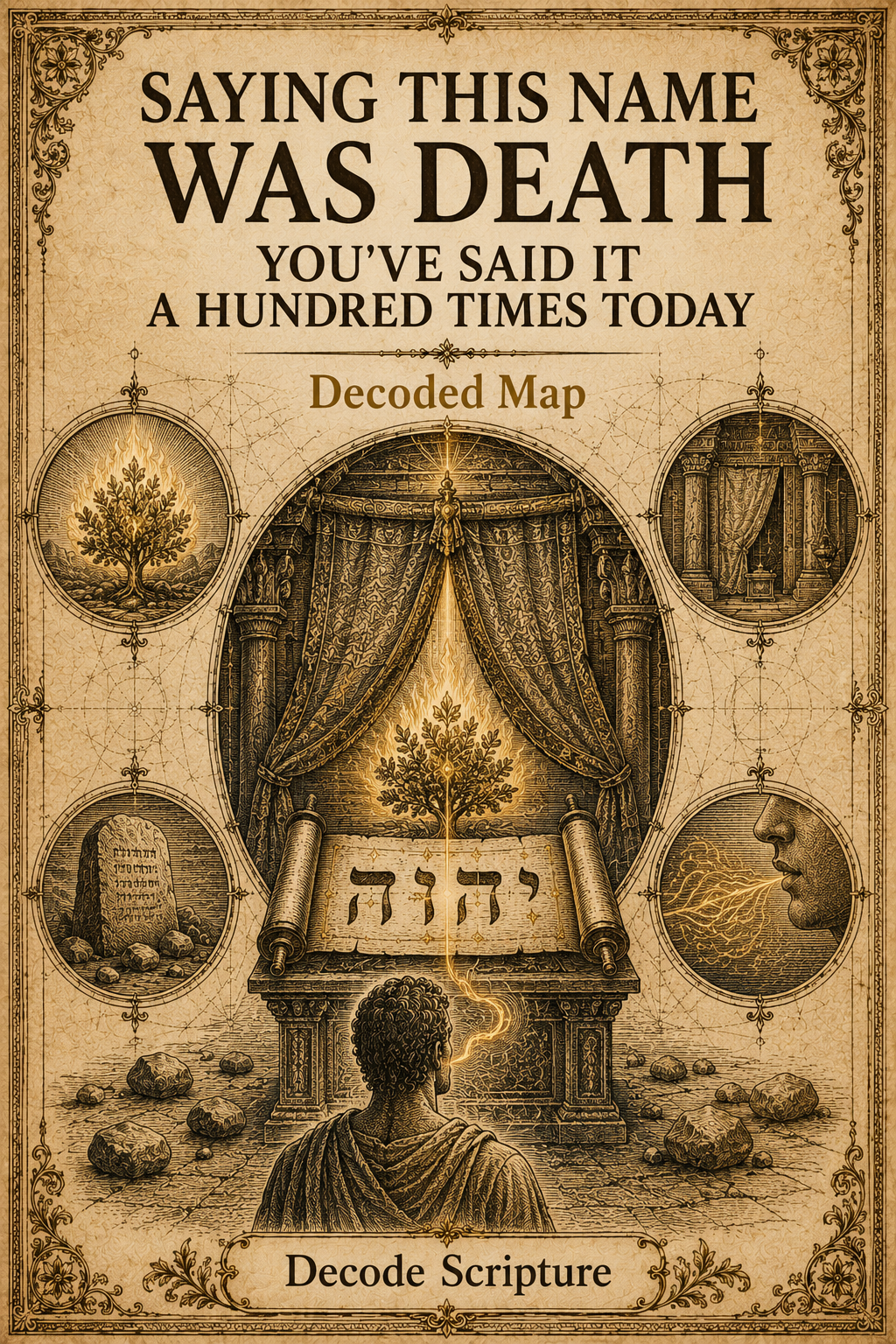
Go deeper into the Decode Scripture episode with this printable Decoded Map on the divine name revealed in Exodus 3:14 and the words "I am."
This PDF companion is designed for personal study and helps you revisit the core structure behind the episode in a clear, written format.
Inside, you'll find:
• the surface reading of the divine name as a distant sacred title guarded from ordinary speech
• the decoded meaning of ehyeh asher ehyeh as the first-person verb of being
• key verses decoded from Exodus 3:14, Leviticus 24:16, John 8:58, John 8:59, John 10:30-33, and John 18:5-6
• the connection between ehyeh, the four-letter divine name, and the language of existence
• the historical taboo surrounding pronunciation of the name in Greek scripture and the Dead Sea Scroll community
• the repeated reaction to Jesus placing "I am" on his own tongue
• a practice section for hearing the words "I am" as the ordinary language of being rather than passing over them automatically
This Decoded Map explores the divine name not simply as a distant title of power, but as language built from the verb "to be."
In Exodus 3:14, Moses asks for a name and receives ehyeh asher ehyeh. The word ehyeh is the first-person form of the Hebrew verb of being and can carry the sense "I am" or "I will be." The map follows the relationship between that first-person expression and the four-letter divine name derived from the same verbal root.
It also examines why the name became surrounded by such severe restrictions. Leviticus places death around blaspheming the name, while the Greek scriptures sharpen the issue around naming or pronouncing it. The Dead Sea Scroll community also preserved rules against speaking the divine name aloud.
The study then follows the pattern into John. In John 8:58 Jesus says, "Before Abraham was, I am," and the immediate response is an attempt to stone him. John 10 records another charge of blasphemy, while John 18 places the same "I am" language at the arrest scene, where those approaching him draw backward and fall.
The map's central claim is that the language treated as distant and forbidden is also the most ordinary first-person language a human being uses: "I am awake," "I am tired," "I am afraid," "I am fine."
The practice section asks you to notice that phrase when it appears in ordinary speech and hear the verb itself before immediately covering it with an identity, emotion, condition, or description.
Important: If you are already a Cartographer member, do not purchase this separately. This Decoded Map is already included in your membership library.
This single purchase is for viewers who want the written companion map for one public Decode Scripture episode as a standalone download.
For access to all current public episode maps, future maps, members-only videos, and members-only PDFs, join The Cartographer tier.
Delivery: This is a digital download. No physical item will be shipped.
Share